How PRs work

How are PRs calculated?

A set is a PR when no other counted set on the lift matches or beats it on both weight and reps. That one rule is why a heavy single and a high-rep set can both be records.

The rule

Matches or beats, on both.

A set is a PR if nothing dominates it.

Callus compares a set with the other counted sets on the same lift. If any one of them has at least as much weight and at least as many reps, the new set is not a PR. If none does, it is.

A counted set is a confirmed set that is not deleted, not a warm-up, not in a deleted session and not in a deload session (a set without a session counts), and is not a zero-rep set unless it is timed. Everything else is left out of the comparison, so a heavy warm-up never stops a working set from being a PR.
Why a rep PR and a weight PR coexist.

120 kg for 5 does not match or beat 100 kg for 12 on both numbers, and 100 kg for 12 does not match or beat 120 kg for 5. Neither dominates, so both are PRs. 100 kg for 10 would not be one: 100 kg for 12 matches its weight and beats its reps.

Some trackers keep a best per rep count.

That is a sound way to read a lift, and it is simple to follow. Dominance asks a different question: is this set beaten on both numbers by any other counted set, at any rep count?

One real example

Four records on one lift.

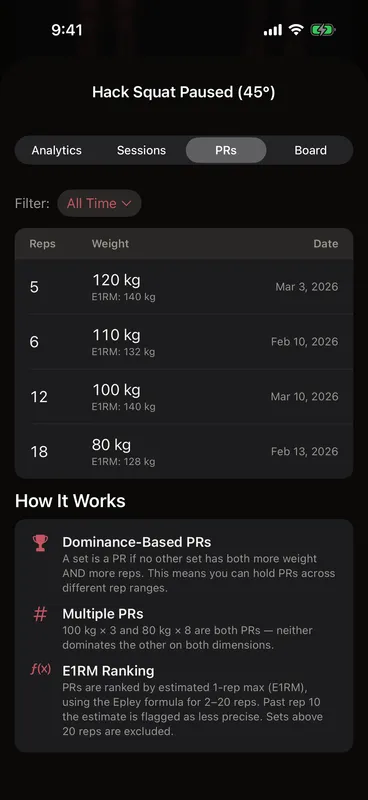
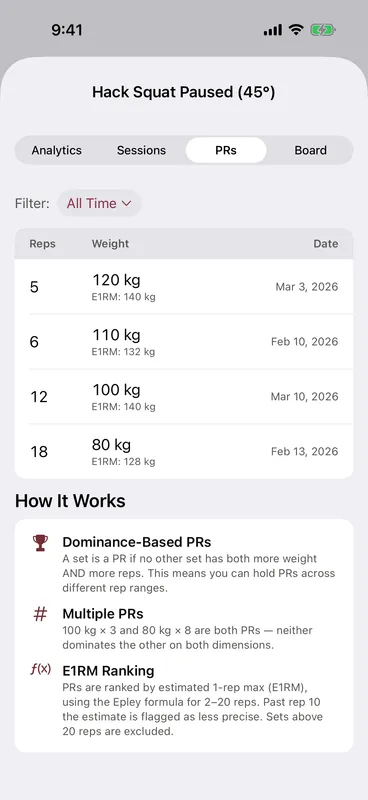
This is a lift's PR table straight from the app, with the name and dates left out. Each row is a PR because no other counted set on the lift matches or beats it on both weight and reps.

Four personal records on one lift
RepsWeight
5120 kg
6110 kg
12100 kg
1880 kg

The app lists these as "Records by rep count", ordered by reps. Each row also shows an estimated 1RM, which is less precise past 10 reps. Separately, the app gives no estimated 1RM above 20 reps.

Callus PRs tab: records by rep count for one lift: personal records at 5, 6, 12 and 18 reps, each row showing an estimated one-rep max, with the dominance rule explained below the table Callus PRs tab: records by rep count for one lift: personal records at 5, 6, 12 and 18 reps, each row showing an estimated one-rep max, with the dominance rule explained below the table

Pound-for-pound

The same rule, per kilo of you.

Relative PRs use your body weight on the day.

Log your body weight and Callus applies the same rule to weight divided by body weight, with reps. It uses the most recent entry on or before the set. With no entry, there is no pound-for-pound PR for that set.

Say pound-for-pound, not stronger.

A better ratio can come from a lighter you. The Hall of Fame's relative mode ranks by estimated 1RM divided by body weight, so it is an estimate, not a measured lift.

The cut tag

A PR you set while cutting.

A PR or pound-for-pound PR gets the cut tag when your body weight is trending down about 2 % or more over four weeks when you log the set. It needs body-weight history to say so.

  1. At least 3 body-weight entries in the last 7 days.
  2. At least 3 body-weight entries from 28 to 35 days ago.
  3. The average of the recent window is 2 % or more below the average of the earlier one.
  4. Less than that, and no tag: Callus does not guess. On Apple Watch the moment reads CUT-ERA PR!

Where this runs

Privacy

Without an account your sets stay on your iPhone and Watch unless you export or share them yourself. Without an account Callus also sends anonymous, install-scoped launch, onboarding, workout-count, paywall and purchase events after you accept the privacy policy, crash reports unless you turn them off, and feedback you choose to send. No ads, no tracking SDKs. Privacy policy.

Callus is pre-launch

See your own records counted.

Your lifter card shows your tier, score and radar once you sign in. Your PRs are counted either way.